Media Art Simulation as System for Autonomous Ecologies
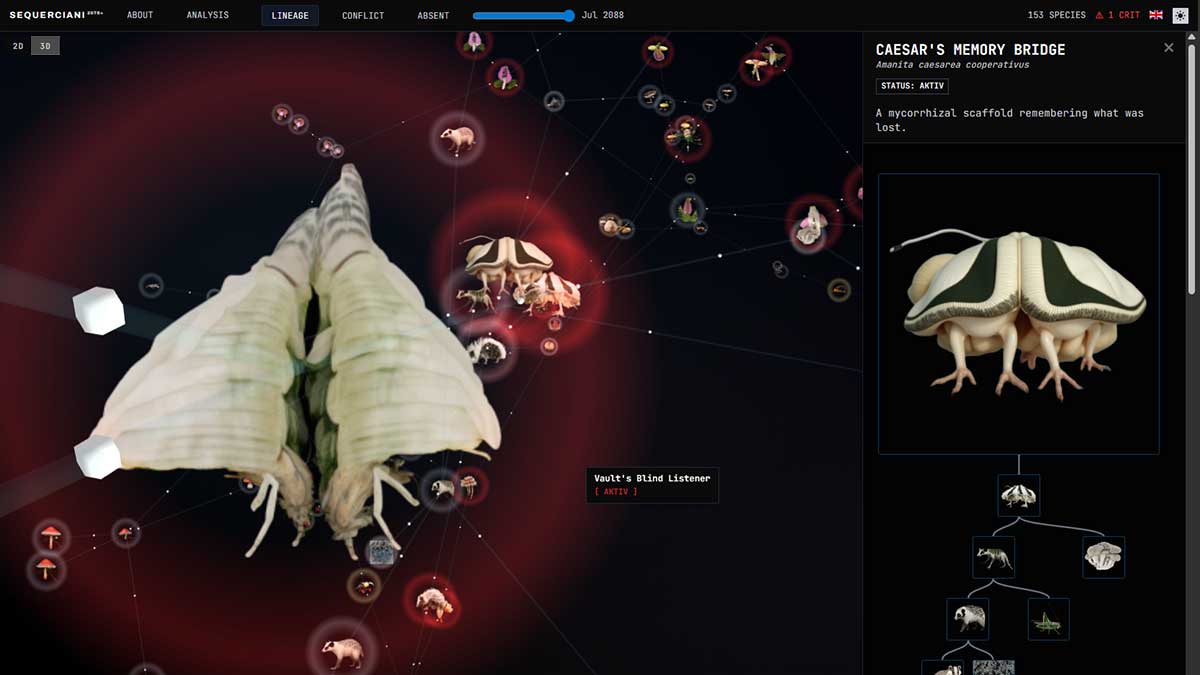
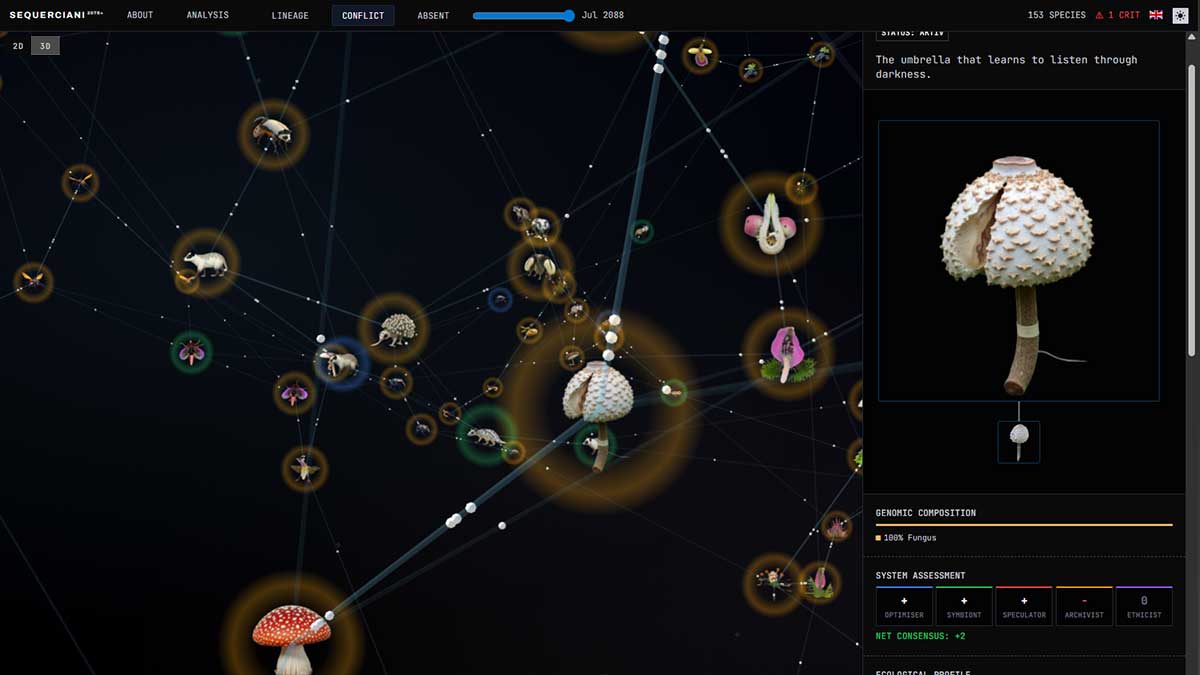
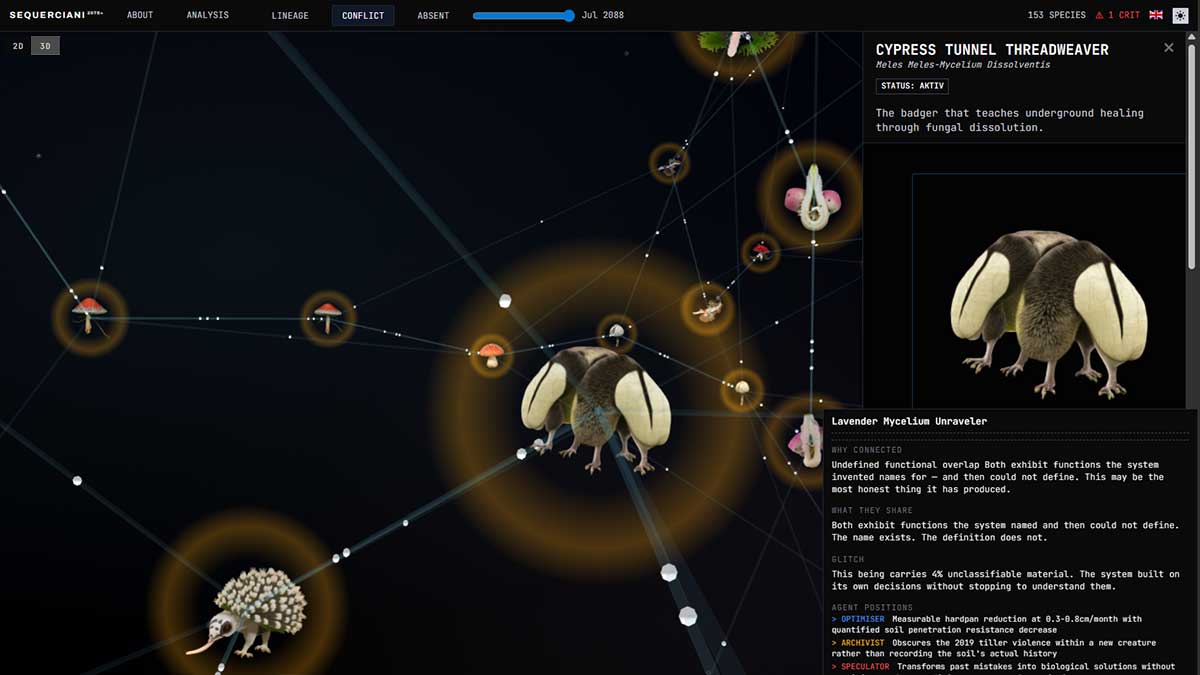
At a time of climate instability and promises of technological solutions, nature is increasingly understood as a system to be monitored, optimised and repaired. Life itself becomes infrastructure, expected to remain functional even under hostile conditions.
Sequerciani 2076+ Specimen Protocols takes this trend to the extreme: in the year 2076, a speculative simulation on the real biodynamic estate of Sequerciani in Tuscany responds, in recurring cycles, to new ecological tensions. To address them, five competing AGI archetypes — Optimiser, Symbiont, Speculator, Archivist and Ethicist — negotiate conflicting ideas of intervention, stabilisation and responsibility. From this process emerge hybrid organisms composed of animals, fungi, plants and robotic systems.
The simulation does not ask whether a combination is “natural”, but whether it stabilises the ecosystem. Each synthesis appears as a form of repair, yet at the same time generates new dependencies, risks and ecological dilemmas, which manifest as unresolved questions. The protocols shown draw their data live from the ongoing simulation Sequerciani 2076+, which is constantly evolving. They present a future that functions, yet confronts us with radical algorithmic otherness.
Exhibition Version / Technical Rider
The presentation of Sequerciani 2076+ Specimen Protocols requires a screen or projector, a mini PC with a web browser in full-screen mode, and an internet connection.
Open exhibition view in full screen
About the Simulation Sequerciani 2076+
Sequerciani 2076+ is an ongoing web-based ecosystem simulation and, at the same time, a speculative future laboratory. Set in the year 2076 on the real Tuscan estate of Sequerciani — a place internationally renowned for regenerative and biodynamic agriculture — the project imagines a scenario in which human agricultural labour has been fully delegated to autonomous systems. Nature is no longer understood as an autonomous counterpart, but rather as a technised system serving as infrastructure. Hybrid organisms made of plants, animals, fungi and robotic systems emerge, continuously observed, assessed, optimised and repaired in order to withstand an increasingly unstable environment.
This ecosystem is managed by five competing AGI swarms whose logics mirror contradictory human worldviews and form the modes of a new algorithmic governance. The Optimiser measures and stabilises, the Symbiont feels and connects, the Speculator invents the radically new. The Archivist preserves and mourns, while the Ethicist continuously asks whose interests remain unconsidered.
These specialised sub-intelligences do not act as isolated figures, but as swarms that autonomously negotiate the transformation of the landscape through server-side processes and numerous API calls.
In continuous cycles, the simulation generates new ecological conditions, debates and systemic reactions. Each cycle begins with a systemic crisis or an ecological imbalance, to which the agents react. Every six real hours – which corresponds to one simulated month within the system – the simulation undergoes a decision-making cycle in which possible interventions are discussed and the emergence of hybrid life forms is negotiated. In this process, the boundaries between flora, fauna, fungi and robotics become increasingly permeable: drones merge with mycelial networks, earthworms interbreed with grapevines. Every 72 hours, a full simulated year passes.
The ecosystem continues to develop, regardless of whether it is being observed by an audience. The simulation presents this world of tomorrow not as a distant dystopia, but as a logical consequence of an already technologised present. Yet the more the system’s internal contradictions grow, the more clearly a digital and ecological glitch emerges: a blur of the unclassifiable, in which the system can no longer comprehend what it has itself created.
Start interactive live simulation
Detailed Concept & Discourse
Research and Context
Sequerciani 2076+ continues the Speculative Evolution series, which was developed, among other places, at transmediale studio in Berlin and during a research residency in Pakistan.
The research included visits to biotechnological institutions such as the Max Delbrück Center for Molecular Medicine in Berlin and LAMS, the Department of Life Sciences in Lahore. Several stays at the Sequerciani Arte Clima Residency in Tuscany deepened the site-specific exploration with regenerative agriculture, biodynamics, agroecology and speculative ecologies.
The project brings together this field research and asks about the sovereignty of the living. What remains of nature when it is reconstructed according to our often contradictory ideas of efficiency, ethics and control? The project aims to inspect our tendency to simplify complex ecosystems and ecological challenges by treating nature as a system that can be fixed. It presents a functioning future, yet confronts us with radical algorithmic otherness.